


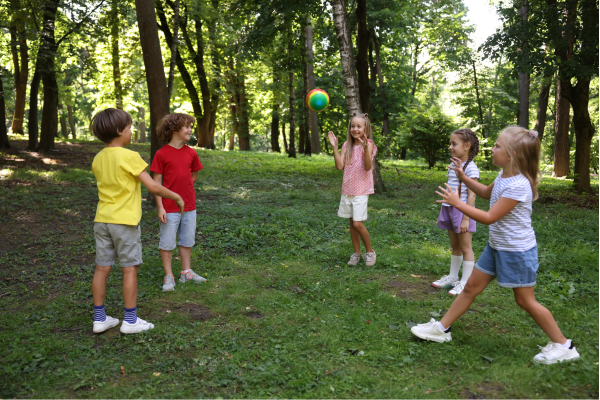
Learning to Play Together: How Play Builds Social Skills and Friendships
As the summer holidays begin, many children spend more time with siblings, friends and extended family. For parents, this often brings a familiar mix of hope and concern: Will they get along? Will they share? Will they make friends?
We all know how important social skills are, and luckily play provides children with one of the most natural and enjoyable ways to develop them, helping them learn how to communicate, cooperate and build friendships.
Social skills are practised, not taught

Children don’t learn how to cooperate, negotiate or empathise simply by being told what to do. They learn through experience in real situations with other people.
Play gives them space to practise:
- Taking turns
- Managing disagreements
- Working towards shared goals
- Waiting and tolerating frustration
- Compromising and adapting when things don’t go their way
It’s important to remember that play won’t always be conflict-free. Disagreements and misunderstandings are a normal part of playing together and can provide valuable opportunities for children to learn about fairness, boundaries and repairing relationships. Rather than rushing to solve every problem, giving children space to work things out for themselves can help build confidence, resilience and stronger social skills.
Different types of social play
Social development doesn’t look the same for every child, and not all social play involves constant interaction. Children develop important social and emotional skills through a variety of play experiences, each offering different opportunities to learn about themselves and others.
Cooperative Play
Cooperative play involves children working together towards a shared goal, whether that’s building something, acting out a role-play scenario or taking part in a team game. This type of play helps children develop communication skills, teamwork, problem-solving abilities and an understanding of how to make decisions together.
Parallel Play
Parallel play is when children play alongside one another without necessarily interacting directly. While it is most common in younger children, it can also be preferred by neurodivergent children or those who enjoy a quieter way of interacting with others. It helps children feel comfortable around others and develop a sense of belonging.
Competitive Play
Games and activities with rules, winners and losers provide valuable opportunities for children to learn about fairness, resilience and emotional regulation. Competitive play helps children practise coping with disappointment, celebrating success appropriately and respecting other players.
Solitary Play
Playing alone is sometimes mistaken for being unsocial, but it plays an important role in healthy development. Solitary play supports creativity, independence and self-confidence, while giving children space to explore their own interests. Children who are comfortable playing independently often find it easier to join group activities when they choose to.
Healthy social development is built through a balance of these different types of play. Each offers unique benefits and helps children develop the skills they need to build positive relationships throughout their lives.
The myth of constant sharing and togetherness

Children are often encouraged to always share, always include others, and always play together. While cooperation is an important life skill, constant enforced togetherness can sometimes create pressure rather than connection.
Children also need space to:
- Set boundaries and say no
- Protect their ideas, creations and roles in play
- Play independently without interruption
- Step in and out of group play when they are ready
For children, learning when to step back is just as important as learning how to join in. So respecting a child’s need for space does not reduce their social development, it can actually strengthen it.
When social play becomes challenging

It is also important to recognise that social play is not always straightforward. Moments of tension are normal, especially when children are:
- Tired or overstimulated
- Navigating new friendships or groups
- Working with different personalities and expectations
There could be disagreements over rules, frustration about turn-taking, or confusion about shared goals. And although these moments can feel uncomfortable for adults to watch, they are often where some of the most important learning happens, particularly around negotiation, empathy and repair after conflict.
When toys help and when they hinder

Not all “social” toys work in the way they’re intended. Their impact depends on how children actually use them in play. Some toys encourage natural interaction, conversation and shared problem-solving. Others can actually make social play harder, so avoid toys and games that:
- Limit turns too strictly
- Create an uneven balance between players
- Rely on skills that not everyone has
- Leave little room for children to adapt the game
The most valuable toys and games are often those that can be adapted and played with in multiple ways, allowing children to shape the play together.
How the Good Play Guide looks at social play value

When reviewing toys and games that involve more than one child, the Good Play Guide looks at how children actually use them together, not just whether they are labelled as “social”.
We consider whether they:
- Help children interact naturally
- Can be played in different ways
- Are suitable for the child’s age and stage
- Feel fun as well as challenging
- Encourage talking, sharing and problem-solving
This helps families choose toys that genuinely support social development, not just promise it.
Supporting friendships over the summer

The summer holidays give children more time to build friendships outside the routines and pressures of school. With fewer structured activities, they have space to try out different roles, explore relationships and learn how to play together in their own way.
Adults can support this by:
- Giving children time and space to play freely
- Not stepping in too quickly to sort out small disagreements
- Accepting that friendships naturally change
- Understanding that not every play session will run smoothly
It can be tempting to step in when children fall out, but these moments are often an important part of learning how to get along with others. Social skills don’t come from perfect playtimes, they come from experience, which means trying things out, making mistakes, sorting things out and trying again.